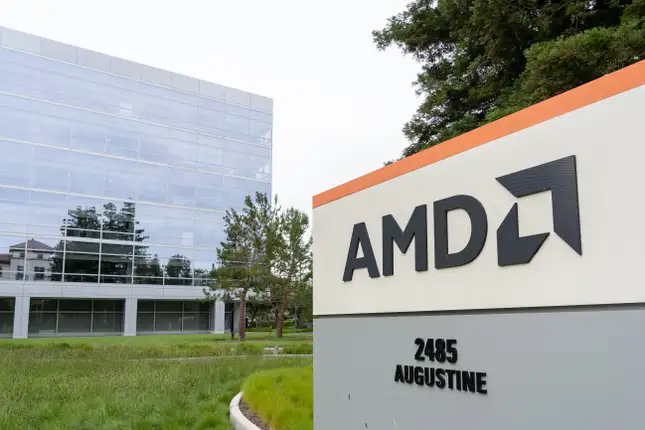
2025 was a year of significant strides for Advanced Micro Devices (AMD), marked by strategic expansions in the AI and data center markets, and strong growth in client CPU sales. As the tech world converges in Las Vegas for CES 2026, all eyes are on AMD to see how they will build upon this momentum and further solidify their position as a key player in the semiconductor industry.
2025: A Year of Solid Growth and Strategic Partnerships
AMD's first quarter earnings in 2025 showcased a 36% year-over-year revenue increase, reaching $7.4 billion. This growth was fueled by a 57% surge in data center revenue, driven by the adoption of fifth-generation EPYC Turin processors and continued demand for fourth-generation EPYC CPUs. The company also saw a significant 68% year-over-year increase in client CPU sales. Throughout the year, AMD launched several new processors, including the Ryzen AI Max Plus, AI 7, and AI 5 series, which received positive market response.
Beyond financial performance, 2025 was notable for AMD's strategic partnerships, particularly in the AI space. The company forged alliances with industry giants like OpenAI and HPE, positioning itself as a key supplier of AI semiconductors and challenging Nvidia's dominance. These partnerships are expected to shape the future of AI infrastructure and drive further growth for AMD in the coming years. AMD also expanded its collaboration with HPE around Helios, promising high-bandwidth, low-latency rack-scale connectivity.
CES 2026: AI Everywhere, For Everyone
At CES 2026, AMD CEO Dr. Lisa Su presented the company's vision for "yotta-scale computing," outlining its roadmap for AI infrastructure, enterprise accelerators, and next-generation GPUs. A key announcement was the "Helios" rack-scale platform, which packs 3 AI exaflops into a single rack using the new Instinct MI455X GPUs and EPYC "Venice" CPUs. This infrastructure is designed specifically for training trillion-parameter AI models, with partners like OpenAI and Blue Origin already testing the technology. AMD also introduced the Instinct MI440X GPU for enterprise customers seeking on-premises AI deployments without massive infrastructure investments.
AMD's focus on AI extends beyond the data center and into consumer devices. The new Ryzen AI 400 Series processors, based on the Zen 5 architecture and featuring second-generation XDNA 2 NPUs, are designed for Copilot+ PCs and offer up to 60 TOPS of AI compute. The Ryzen AI Max+ variants boast up to 128GB of unified memory, enabling users to run large AI models directly on their laptops or small desktops. To support AI development, AMD introduced the Ryzen AI Halo Developer Platform, providing programmers with a dedicated desktop tool.
AMD is also bringing AI to edge devices with its new Ryzen AI Embedded processors. These chips, divided into the P100 and X100 Series, are designed for automotive, industrial, and autonomous systems, enabling split-second decision-making in tight spaces and power-constrained environments.
Looking Ahead: Challenges and Opportunities
While AMD has made significant progress, challenges remain. Competition in the AI chip market is fierce, with Intel and Nvidia also vying for market share. AMD needs to convince commercial clients that its products are superior and continue to strengthen its ecosystem. Supply chain issues also pose a challenge for AMD and the entire industry.
Despite these challenges, AMD is well-positioned for continued growth in 2026. Wall Street analysts project a 35%+ CAGR and an average price target of $277 for AMD stock, with some setting a high of $380. The company's focus on AI, its strategic partnerships, and its broad portfolio of products, ranging from data center GPUs to consumer CPUs, make it a compelling player in the semiconductor industry. As AMD continues to execute its roadmap and capitalize on the growing demand for AI and high-performance computing, it is poised to deliver on its vision of "AI everywhere, for everyone".